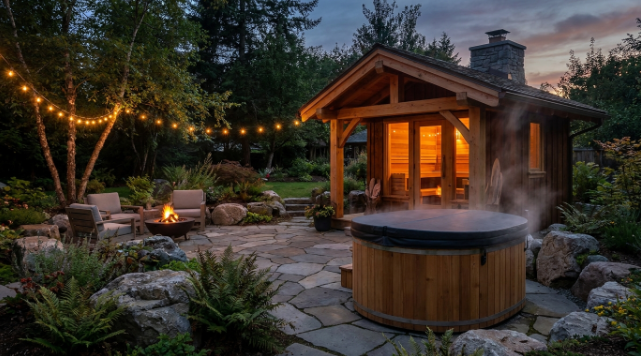
Pairing a 4-person sauna with a cold plunge for contrast therapy typically means 15 to 20 minutes of heat at 170 to 180 degrees followed by 1 to 3 minutes of cold water at 50 to 59 degrees, repeated for 2 to 3 rounds. The heat phase drives up heart rate and skin blood flow, while the cold phase constricts blood vessels sharply, and cycling between the two is associated with better circulation and a stronger subjective recovery feeling in several cohort studies. A 4-person cabin gives a household or a small group enough room to run this routine together without waiting on a single 2-person unit to clear out between rounds.
Why Does a 4-Person Cabin Work Better for Group Contrast Sessions?
Contrast therapy is more sustainable as a habit when more than one person can do it at the same time, and a 4-person cabin is sized for exactly that. With four people rotating between a shared sauna and a single cold plunge tub, the sauna stays occupied and warm while each person takes their turn in the cold water, instead of the heater cycling down between solo sessions. The extra bench space also means someone easing into their first cold plunge can sit on the cooler lower tier for a shorter warm-up round while more experienced users take the longer upper-tier sessions.
See also: The Sermorelin File: Who Picks Up the Tab When the Vial Lies
What Does a Typical Contrast Session Look Like?
Most people start with 15 to 20 minutes in the sauna to raise core temperature and get a good sweat going, then move directly into a cold plunge at 50 to 59 degrees for 1 to 3 minutes. That is one round. Two to three rounds is a common total session length, and where you finish matters: ending on cold tends to leave people feeling alert and ready to start the day, while ending on heat is more common for an evening wind-down routine before bed. Between rounds, a short rest of 2 to 3 minutes at normal temperature lets heart rate settle before the next heat or cold exposure.
How Much Space and Equipment Does This Setup Need?
A 4-person cabin runs roughly 280 to 340 cubic feet of interior space, big enough for a small group to rotate through comfortably. A cold plunge tub adds another 4 to 6 feet of clearance for entry and exit, plus room nearby for a chiller unit if the plunge is not simply filled with ice and refreshed manually. Households setting up both from scratch often start by browsing a dedicated sauna collection, since matching heater output and bench count to how many people will actually use the cabin at once matters more here than in a single-user setup; a source like browse SweatDecks 4-person saunas is a reasonable starting point for comparing capacity against footprint before adding the plunge. Drainage for the cold plunge, whether to a floor drain or a simple gravel bed, is worth planning at the same time as the sauna’s electrical run so both installations happen in one pass.
What Does the Research Actually Show About Contrast Therapy?
The strongest evidence for sauna bathing itself comes from Finnish cohort research. A widely cited study in JAMA Internal Medicine followed men over roughly two decades and found that those who used a sauna four to seven times a week had lower rates of fatal cardiovascular events and all-cause mortality than men who used one once a week, an association that held after adjusting for other risk factors. A related long-term cohort study in Annals of Medicine found that combining regular sauna bathing with higher cardiorespiratory fitness was jointly associated with lower cardiovascular and all-cause mortality risk. A shorter-term study in Heart and Vessels measured blood-based cardiovascular markers immediately after Finnish sauna sessions in non-naive users, finding measurable short-term changes consistent with the longer cohort findings. None of these studies isolated the cold-plunge half of a contrast routine, so the strongest evidence here is really about the sauna component, with cold exposure layered on as a complementary practice rather than one with its own dedicated long-term mortality data.
Does Cold Plunging Undercut Training Gains?
This is the honest caveat that gets left out of most contrast therapy content. Cold-water immersion performed right after resistance training has been associated in some trials with blunted strength and muscle-size gains over time, likely because the cold exposure interferes with the inflammatory signaling that drives adaptation. This does not mean cold plunging is bad for recovery in general, but someone training specifically to build muscle or strength may want to keep hard lifting days separate from contrast sessions, or plunge several hours after training rather than immediately following it. For general recovery, stress relief, or simply feeling better after a workout, the tradeoff is less relevant.
How Should Beginners Ease Into a Contrast Routine?
Someone new to contrast therapy does better starting with a shorter, gentler version rather than the full 15-to-20-minute and 1-to-3-minute pattern on day one. A reasonable starting point is 10 minutes in the sauna at a moderate 160 to 165 degrees, followed by 30 to 60 seconds in cold water closer to 59 degrees than 50, for a single round rather than two or three. Extending both the heat exposure and the cold duration over several weeks, once the initial shock of the cold plunge feels manageable, lets the body adapt gradually. Rushing straight into the longer protocol described above is a common reason people try contrast therapy once and decide it is not for them, when a slower ramp-up would likely have worked.
Who Should Be Cautious With Sauna and Cold Plunge Combinations?
The temperature swings in a contrast routine put real, measurable stress on the cardiovascular system, since heat dilates blood vessels and cold constricts them sharply within a short window. Most healthy adults tolerate this well, but anyone with unstable angina, a recent heart attack, uncontrolled high blood pressure, or who is pregnant should get individualized medical guidance before starting, rather than treating a home sauna and cold plunge combo as automatically low-risk. Starting with shorter exposures on both ends of the temperature range and extending gradually is a reasonable way to gauge tolerance before committing to the full 15-to-20-minute and 1-to-3-minute pattern.
Frequently Asked Questions
How do you sequence a 4-person sauna and a cold plunge for contrast therapy? A common pattern is 15 to 20 minutes in the sauna at 170 to 180 degrees, followed by 1 to 3 minutes in cold water around 50 to 59 degrees, repeated for 2 to 3 rounds.
How much space does a sauna and cold plunge combo need? A 4-person cabin needs roughly 280 to 340 cubic feet, plus 4 to 6 feet of clearance for the plunge tub and chiller.
Does cold plunging after a sauna session hurt muscle recovery? Some research suggests it may blunt strength and hypertrophy gains when done right after resistance training, so hard training days and contrast sessions are worth separating.
Is contrast therapy safe for everyone? Most healthy adults tolerate it well, but anyone with a heart condition or uncontrolled blood pressure should get individualized guidance first.
References
- Association between sauna bathing and fatal cardiovascular and all-cause mortality events, JAMA Internal Medicine, 2015
- Joint associations of sauna bathing and cardiorespiratory fitness on cardiovascular and all-cause mortality risk, Annals of Medicine, 2018
- Short-term effects of Finnish sauna bathing on blood-based markers of cardiovascular function in non-naive sauna users, Heart and Vessels, 2018
By Priya Chandran